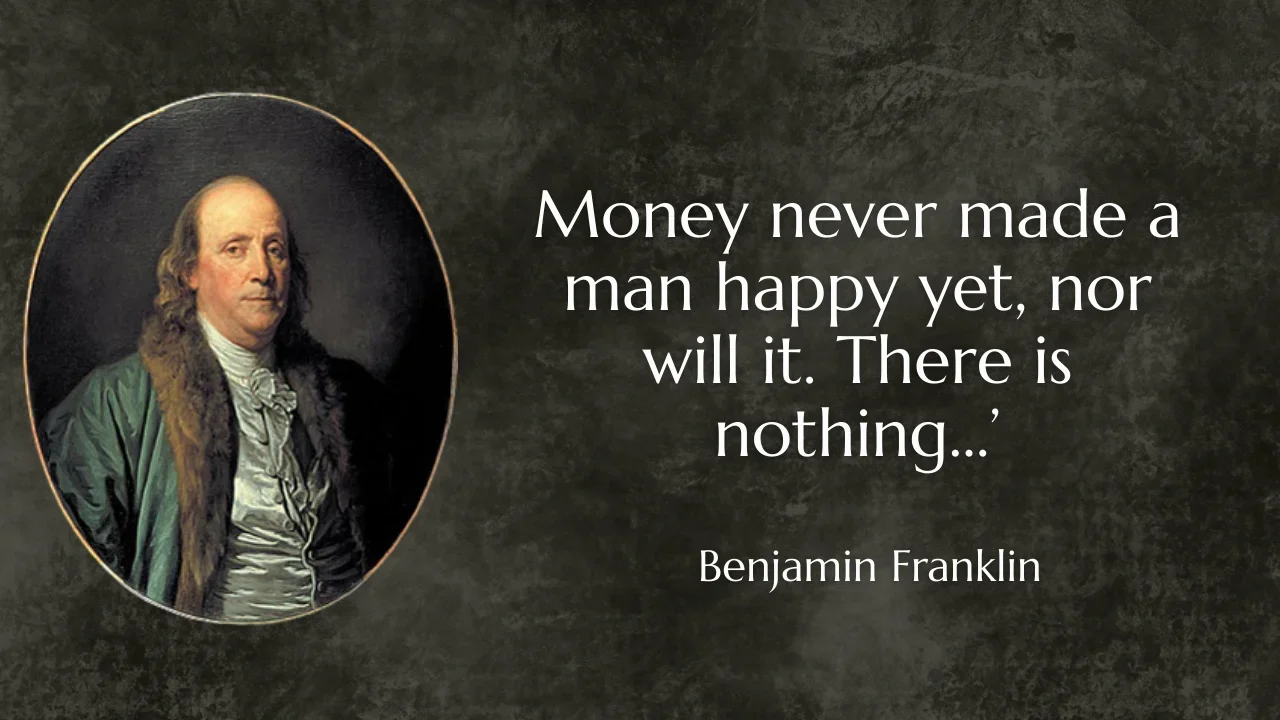
Quote of the Day By Benjamin Franklin: The quote of the day by Benjamin Franklin hits different in a world where wealth often measures worth. “Money never made a man happy yet, nor will it,” is not just a clever phrase—it is a truth that shakes the very foundation of how many people chase happiness today. Spoken by a man whose face is printed on the hundred-dollar bill, this quote forces us to question what truly brings joy. Does the number in your bank account really reflect the quality of your life?
The reason this quote of the day by Benjamin Franklin feels so timeless is because Franklin lived a life that reflected more than wealth. He was not against making money, but he knew it could never be the final goal. This article digs into what Franklin meant, why it matters today, and how his values still hold strong in a world obsessed with material success.
Quote of the Day By Benjamin Franklin
The quote of the day by Benjamin Franklin is far more than just words—it is a philosophy. “Money never made a man happy yet, nor will it. There is nothing in its nature to produce happiness.” These are the thoughts of a man who had seen both poverty and prosperity. He understood that while money can solve problems, it cannot fill the deeper emotional needs we all have.

Franklin did not reject wealth, but he did reject the idea that it alone could lead to joy. He believed that fulfillment comes from purpose, learning, service, and meaningful relationships. In today’s world, where many are burned out chasing careers and incomes, his wisdom offers a pause. The idea is not to avoid money, but to not confuse it with happiness.
Overview Table
| Key Point | Details |
| Full Quote | “Money never made a man happy yet, nor will it…” |
| Who Said It | Benjamin Franklin |
| Main Message | Money alone cannot bring real happiness |
| Context of the Quote | Shared later in Franklin’s life after years of experience |
| Modern Relevance | Speaks directly to today’s struggle with materialism |
| His Personal Beliefs | Valued knowledge, service, and virtue over wealth |
| Ironic Fact | Appears on the $100 bill despite warning about money |
| Lifestyle Focus | Centered on invention, civic duty, and wisdom |
| What Readers Can Learn | Look beyond money to find purpose and long-term satisfaction |
| Emotional Impact | Encourages deeper thinking about what truly brings contentment |
Early Life of Benjamin Franklin
Franklin’s story starts in humble beginnings. Born in 1706 in Boston, he was the eighth of seventeen children. His family was not wealthy, and his formal education ended by age ten due to financial constraints. Yet his curiosity and ambition were unstoppable. He began working in his brother’s print shop, where he learned the value of hard work and self-education.
By the age of seventeen, Franklin had moved to Philadelphia, determined to build a better life. With no money and few connections, he carved a path using nothing but his intellect and grit. These early experiences shaped his understanding that success is not handed to you, and that true wealth lies in the effort you put into growing yourself.

Climbing the Social Ladder
Franklin’s rise was not about chasing riches—it was about creating impact. He became a successful printer and publisher. His paper, The Pennsylvania Gazette, and his famous Poor Richard’s Almanack gave practical advice to common people. His words connected with everyday readers because they came from real experiences.
In 1737, he was appointed Postmaster of Philadelphia. This role opened doors to powerful networks. Franklin’s focus was always on contribution—he helped improve mail systems, created the first public library, and co-founded a hospital. He used influence not to get richer, but to build systems that served others. His life proves that legacy is built on actions, not income.
The American War for Independence
When Franklin returned to America in 1775, the colonies were on the edge of war with Britain. He joined the Continental Congress and helped draft the Declaration of Independence. He was no longer just a thinker—he became a founding father of a new nation. Despite poor health, Franklin’s voice helped shape one of the most important moments in American history.

Later, he was sent to France to secure support for the revolution. His ability to connect, persuade, and build trust helped gain the French alliance. This turned the tide of the war. Franklin’s work was not about personal gain—it was about securing freedom. He showed that service to others can bring far more satisfaction than any paycheck.
Virtue Over Wealth: The True Legacy
Franklin’s words and actions consistently pointed toward one belief: inner value is greater than outward wealth. He is known for saying, “Content makes poor men rich; discontent makes rich men poor.” That idea runs deep in his philosophy.
Even as he became well-known and respected, Franklin remained focused on learning, community, and progress. He invented useful tools, championed education, and helped shape the nation’s systems—not to earn money, but to leave something meaningful behind. He lived his quote fully. His wealth was in wisdom, and that is what made him truly rich.

Two Important Lessons from Franklin’s Life
- Chasing Money Does Not Guarantee Fulfillment
Franklin’s quote teaches that pursuing wealth without purpose often leads to emptiness. True happiness comes from growth, connection, and service. - Your Legacy Is Defined by Actions, Not Assets
His most lasting contributions—libraries, diplomacy, inventions—were not about money. They were about helping others and building a better future.
FAQs
1. Why did Benjamin Franklin say money never made a man happy?
He believed that happiness comes from values, purpose, and relationships—not material gain. Money can provide comfort, but not true joy.
2. Did Franklin live by this belief in his own life?
Yes. He focused on education, public service, and innovation rather than personal wealth. He gave more to society than he took.
3. What makes this quote still relevant in 2026?
In a time when consumerism dominates, this quote is a reminder to focus on what truly matters—personal growth and meaningful connections.

4. Why is it ironic that Franklin is on the $100 bill?
Because he warned against chasing money, yet his face represents one of the highest denominations in U.S. currency. That irony makes his message even stronger.
5. What can readers take from this quote today?
They can reflect on their own goals and ask themselves if they are chasing money or meaning. The quote challenges people to find deeper value in life.