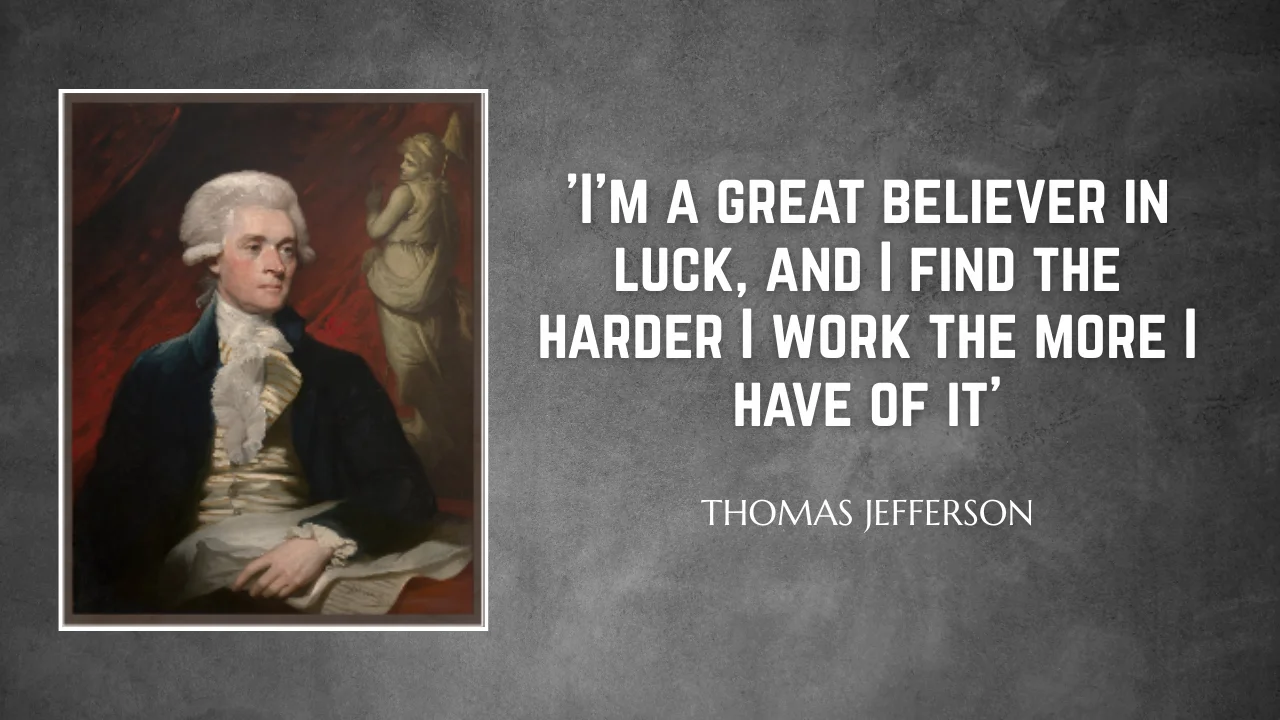
Quote of the day by Thomas Jefferson: The quote of the day by Thomas Jefferson is one of those timeless reminders that still feels fresh and real in today’s world. His words, “I’m a great believer in luck, and I find the harder I work the more I have of it,” flip the idea of luck upside down. Rather than something random or magical, Jefferson saw luck as something you earn by showing up, putting in the effort, and staying consistent.
This perspective is powerful because it shifts control back to you. Instead of waiting for the right moment, the right connection, or a lucky break, Jefferson encourages you to build those moments through action. That is exactly what this article will explore. Using the quote of the day by Thomas Jefferson as a starting point, we will look at the deeper meaning behind it, how it reflected his life and choices, and why it still holds so much value today.
Quote of the day by Thomas Jefferson
This quote is more than just a motivational line. It captures a mindset that links preparation, persistence, and opportunity. It is about trusting the process. When you work hard consistently, you are not leaving success to chance—you are building the conditions where it can happen. That is what makes this quote by Jefferson so enduring. It touches on something real: the connection between daily effort and long-term reward.

Jefferson lived this belief. He did not become a leader overnight. He studied for years, made sacrifices, wrote with purpose, and showed up when it counted. Whether in law, politics, or education, his success was not handed to him. It was built. His life teaches us that working hard does not just lead to results—it also attracts opportunities that may look like luck to others.
Overview Table: Key Highlights from Jefferson’s Life and Philosophy
| Aspect | Details |
| Full Quote | “I’m a great believer in luck, and I find the harder I work the more I have of it.” |
| Core Meaning | Luck follows effort, not the other way around |
| Author of the Quote | Thomas Jefferson |
| Born | April 13, 1743, Albemarle County, Virginia |
| Education | Studied at College of William and Mary |
| Major Achievement | Author of the Declaration of Independence |
| Presidential Term | Third President of the United States (1801-1809) |
| Notable Legacy | Founded University of Virginia |
| Famous Contradiction | Advocate of liberty but enslaved over 600 people |
| Date of Death | July 4, 1826, exactly 50 years after Independence |
Jefferson’s Early Life and Foundations
Thomas Jefferson’s early years were not shaped by pure privilege alone. While he was born into a well-off Virginia planter family, he chose to push himself beyond inherited comfort. From a young age, Jefferson committed to education and self-improvement. He read widely, studied deeply, and built a solid foundation for a career rooted in knowledge and responsibility.
He attended the College of William and Mary, where Enlightenment thinking influenced his views. His curiosity stretched from classical languages to science and law. Jefferson’s early focus on learning was not accidental—it was intentional, built on the very idea that hard work leads to real growth. His daily habits and focus reflected the core message behind his quote, that action leads to luck.

Role in the American Revolution and Governance
When the colonies stood at a crossroads, Jefferson was not a passive bystander. He was appointed to the Continental Congress and asked to draft the Declaration of Independence. This task was not assigned by accident. It came from years of intellectual preparation and a strong voice shaped by clarity and courage.
After independence, Jefferson continued to shape governance. He revised state laws, introduced the Virginia Statute for Religious Freedom, and served in the Virginia House of Delegates. These roles were not glamorous but required real work. Each policy, speech, and decision reflected deep engagement and consistent effort. That is why Jefferson’s words about luck feel earned, not imagined.
Presidency and Lasting Impact
Jefferson became the third President of the United States in 1801. His presidency marked important milestones like the Louisiana Purchase, which doubled the size of the country, and the Lewis and Clark expedition, which opened the West. But perhaps more importantly, his time in office was marked by restraint. He avoided costly wars, reduced national debt, and focused on practical governance.

These were not flashy moves but strategic ones, showing that leadership often means choosing what not to do. Jefferson’s presidency proves again that consistent action—not random fortune—leads to real impact. And yet, it is important to acknowledge his contradictions. Though he advocated liberty, he enslaved hundreds, a fact that complicates how we view his life and values.
Jefferson’s Contributions to Education and Culture
Jefferson’s passion for learning never faded. After his presidency, he returned to Monticello and focused on one of his proudest achievements: founding the University of Virginia. He designed the curriculum, the campus, and the vision. For him, education was not just a tool but a safeguard for democracy.
He also made a huge contribution to American intellectual life by selling nearly 6,700 of his personal books to Congress after the Capitol’s library was burned in 1814. Those books became the foundation of the modern Library of Congress. Jefferson did not believe learning should stop. He practiced what he preached, investing his time and resources in knowledge that would outlast him.

Two Key Lessons from Jefferson’s Quote
- Effort Attracts Opportunity
The more time and energy you put into your work, the more chances you create. That is the real meaning behind Jefferson’s idea of luck. - Stay Ready by Staying Committed
You do not control when opportunity will come, but you do control how prepared you are when it does. Keep showing up, keep building your skills.
FAQs
1. What is the main message of Jefferson’s quote on luck and hard work?
The message is that luck is not random. It often comes to those who are consistently working hard and improving themselves.
2. Why is this quote still relevant today?
Because in any field—business, education, personal growth—consistent effort often leads to success. It encourages personal accountability.
3. How did Jefferson apply this quote in his own life?
Jefferson worked tirelessly in law, politics, education, and writing. His career was built on preparation and long-term effort, not shortcuts.

4. Is there evidence that this quote is authentically his?
While widely attributed to Jefferson, there is debate about its exact origin. Still, it fits well with his values and actions throughout life.
5. How can this quote help someone in their career?
It reminds you to focus on what you can control—your work ethic. Success often comes to those who keep trying, learning, and improving.